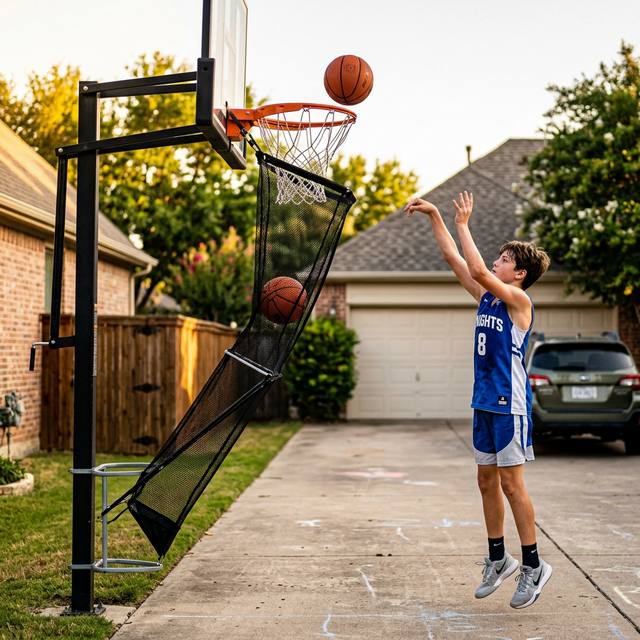
A 90-minute team practice two or three nights a week is not a shooting program. The players who get better between those nights are taking structured reps: same spots, a way to get the ball back, a way to see makes, and one mechanic cue at a time. Random 200s in the driveway are exercise. This page is the home shooting-drill kit — return as a volume tool, spots, a sleeve or arc cue, a rack if you are actually feeding, and a 30-minute script.
It is not another return-system ranking. Model-by-model chutes vs machines live on basketball return systems (frozen URL; we link to it). Standalone pass-back nets are rebounders for solo practice. The broader cart is basketball training equipment. Smart balls and shot-tracking backboards stay on their own URLs.
Desk research: Dr. Dish / SKLZ product sheets, HomeCourt’s published camera-tracking job, and the Amazon mix of chutes, machines, sleeves, and “homecourt” hardware. Not a lab test this desk ran, not a “3–4× faster” development study, and not a star rating. A return that hands the ball back raises volume because you stop chasing — that is a design fact, not a measured 10,000-shot season.
Listing check: Amazon “basketball shooting drills equipment” and “shot trainer” results mix (1) Dr. Dish iC3 hoop-mounted passive return vs Rebel / Home powered machines vs generic “shot trainer” chutes, (2) SKLZ Kick-Out (makes only) vs Solo Assist / multi-sport rebounder nets, (3) HomeCourt the phone app vs a “HomeCourt” hoop or backboard listing, (4) SKLZ Shot Loft / arc hoop vs a compression shooting sleeve vs an elbow “form strap,” and (5) a folding ball rack vs a 500-pound gym rack. Confirm whether the listing returns misses or only makes, whether it mounts to a real rim (not a mini hoop), and whether “HomeCourt” is software. Street prices move; treat any dollar figure here as a listing check, not a lock.
Who should buy this — and who should skip
Driveway / park hoop, ages ~9–17. You have a regulation-height rim (or a hoop you will set to the right height) and someone who will run the same five spots more than once.
Parents feeding. A cheap rack or two extra balls beats a $200 gadget if the bottleneck is “kid waits while you shag.”
Skip first. Skip a $200–500 return on a toy / mini hoop — the chute assumes a real rim and backboard. Skip a powered Dr. Dish machine for a one-car driveway; that is a gym SKU, and the iC3 vs Rebel split is on the return-systems page. Skip a “form strap” that promises to lock the elbow into NBA mechanics. Skip a reaction ball as shooting equipment (it is a handle toy). Skip paying for shot-tracking software before the player has a 20-minute routine they will repeat. Skip sensors and smart balls until the spots exist — smart basketball training aids is the later aisle.
If you do not yet have a hoop, start with adjustable basketball hoops (frozen). Height-by-age is youth hoop height.
The three holes in a home session
Most driveway shooters are missing at least one:
- Get the ball back without a full shag lap.
- Know the spots and the count so Tuesday is comparable to Thursday.
- One mechanic constraint (arc, sleeve feel, or a smaller target) — not all three at once.
Buy in that order. Shooting sleeves and racks are real tools; they are not the first $200.
Ball return (volume, not a trophy)
Without a return, a 30-minute solo session is mostly walking. A hoop-mounted chute that also gathers rim/backboard misses is the usual driveway upgrade. A made-shot-only Kick-Out is cheaper and honest only if the player is already making enough that misses are rare.
The iC3 vs Kick-Out vs powered Rebel decision — including current street bands — is the return systems page. Do not treat this section as a second ranking. Here the only question is: will this kid shoot more structured shots if the ball comes back?
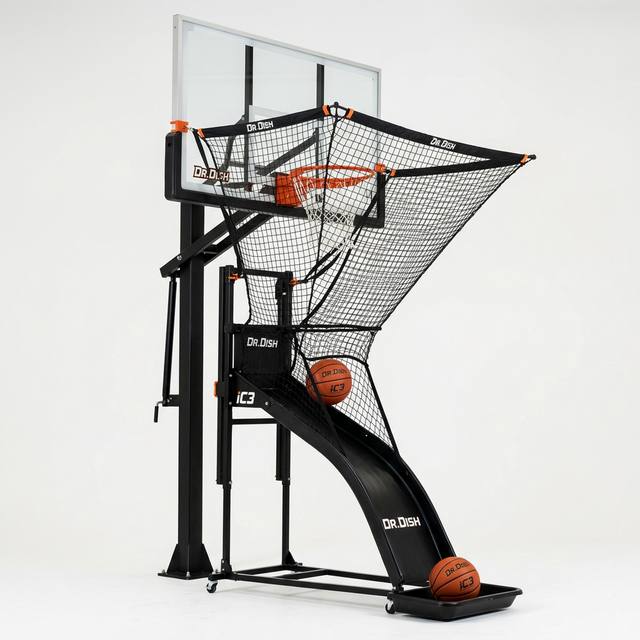 Best Overall
 Dr. Dish
Dr. Dish iC3 Shot Trainer
Passive hoop chute — makes plus many rim/board misses; confirm live street price
Buy the iC3-class chute when the hoop is a real residential rim and someone will shoot 4–5 days a week.
Skip it when the hoop is a portable toy, the driveway is a parking-only slab, or you actually wanted a standalone rebounder (that is the solo rebounder job, not a rim chute).
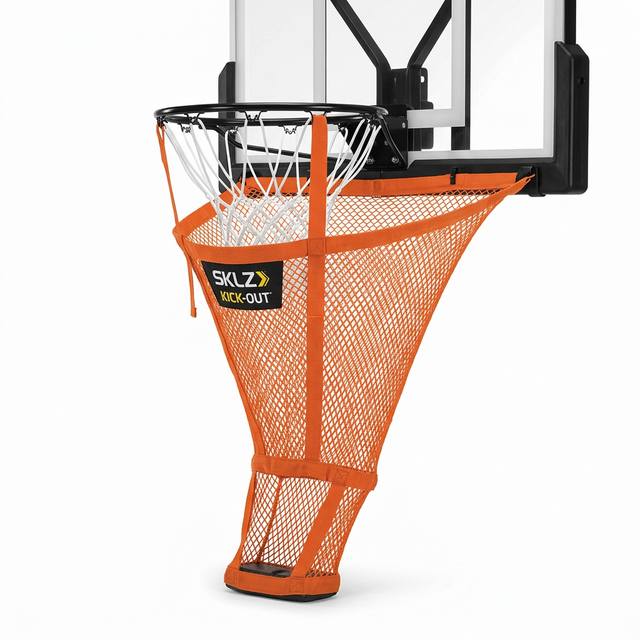 Best Budget
 SKLZ
SKLZ Kick-Out Basketball Rebounder
Made-shot chute — cheaper volume if misses are already rare
A Kick-Out listing that shows a full-size ground rebounder or a soccer face is the listing-check fail.
Structure: spots, counts, and the HomeCourt app
Purposeful practice is “10 from the left corner, write it down,” not a vibes montage.
Dry-erase or rubber spots ($15–25). Corners, wings, elbows, top. SKLZ Court Vision-class dots are the usual set because they stay on concrete better than paper plates. If they slide, they are decoration.
HomeCourt (NEX) the camera app. Phone on a cheap tripod, court in frame, makes/misses logged. The free tier is enough to stop lying about volume. Paid shot charts are a coach-share luxury. Listing check: the App Store product is not a hoop named HomeCourt and not ShotTracker hardware.
Skip first on tracking: a subscription before the player will finish 20 free throws without being asked.
Shooting sleeves (the title item Amazon buries)
A compression sleeve is feel and warmth, not a mechanic teacher. Some kids shoot better when the elbow has a consistent texture; some just like the look.
Buy a sleeve when the player already asked for one and will wear it in games (if the league allows). Match youth vs adult sizing on the spec, not the model in the lifestyle photo.
Skip it when the listing is an elbow strap / “shot corrector” that cinches the joint. That is not a sleeve, and it is not a drill. A “shooting sleeve” title on a resistance band pack is the listing-check fail.
Search youth basketball shooting sleeve and read the size chart. Prices move; the check is youth sizing and a real sleeve, not a strap.
Ball racks (the other title item)
A rack is a feeding tool. It matters when a parent or sibling is rebounding and the player is running a catch-and-shoot circuit. It does almost nothing for a true solo shooter who already has a chute.
Buy a folding / portable rack when you are putting up 50+ catch-and-shoot looks and are tired of a laundry basket.
Skip first on a steel gym rack with casters meant for a rec-center closet. Confirm packed size and whether balls are included (usually not). A “ball rack” title on a return chute is the listing-check fail.
Search portable basketball ball cart.
Mechanic cues (one at a time)
Arc trainer
An under-rim hoop that rejects a flat shot. SKLZ Shot Loft-class. The feedback is binary: it went in the little hoop or it did not. That is more useful than saying “shoot higher” for the fifth time.
Skip it when the player still travels on the gather — fix the feet before you buy geometry.
Smaller rim target
A center-hole insert that turns a make that kissed iron into a miss. Honest accuracy feedback. Useless if the chute cannot return the miss.
Not this page: reaction balls
An odd-bounce ball is a handle / reaction toy. Fine in a training equipment bag. It is not shooting-drill equipment. We keep one search card only so you do not buy it thinking it is a shot trainer.
 Not a shot trainer
 SKLZ
SKLZ Reaction Ball Training Aid
Handle toy — skip if you came here for shooting volume
A 30-minute script (the actual product)
Equipment does not matter if the session is shapeless.
- Warm-up (5 min): form shots, 5–8 feet, both elbows.
- Spots (15 min): five spots × a fixed count (10 or 20). Write makes.
- Off the dribble (5 min): one or two dribbles, elbows only.
- Free throws (5 min): a set of 20, then 10 “game” singles.
Weak-side gaps show up when you write the spots down. That is the point of the dots, not a claimed 25–30% split from a study we did not run.
Buy order if you are starting from zero
- A hoop that is the right height — adjustable hoops.
- Return (Kick-Out or iC3-class) or a rebounder if the chute will not fit — see the two siblings above.
- Spots + a notes app (or HomeCourt free).
- One form cue (arc or sleeve, not both in week one).
- Rack only if a second person is feeding.
A serious driveway kit is still a few hundred dollars, not a gym machine. Budget framing: youth sports tech budget.
Frequently asked questions
Do I need a sleeve and an arc trainer?
No. Pick the cue the player will feel. Stacking both is how the session becomes costume.
Is HomeCourt worth paying for?
Pay when a coach asked for charts. The free camera count is the habit tool.
iC3 or a rebounder net?
Rim chute if you shoot at your hoop. Standalone net if you want pass-backs without a rim mount — rebounders.
Related Articles
How we evaluate: We combine manufacturer documentation, independent user feedback, and parent-focused criteria like safety, durability, ease of use, and long-term value.
Accuracy note: Pricing and product availability can change. Verify details on the retailer site before purchase.
Affiliate Disclosure: Sports Gadget Review is a participant in the Amazon Services LLC Associates Program. When you purchase through links on this page, we may earn a commission at no extra cost to you. Editorial recommendations are made independently.