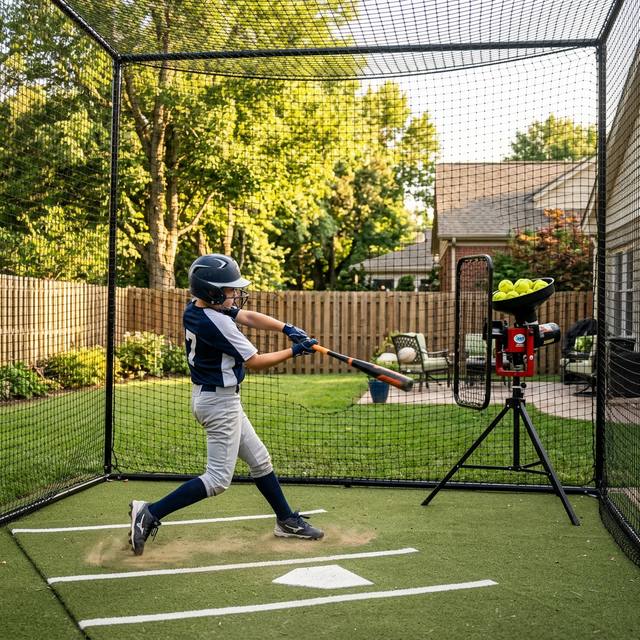
A home “batting cage” on Amazon is often not a cage. It is a 7×7 hitting net, a 22-foot pop-up tunnel, or a pitching machine photographed inside someone else’s frame. Buy the enclosure you measured, then decide whether you need a machine at all.
This page is the backyard cage + when to add a machine guide. The youth first-buy order (net + tee + balls, then upgrades) is the frozen keeper: best baseball training equipment for youth. The category explainer is baseball training equipment. Machine speed, ball type, and budget tiers live on pitching machines for youth baseball.
Desk research only: live listing checks (September 2026), manufacturer dimensions, and the setup complaints that repeat. No named reviewer and no claim that this desk assembled every tunnel.
Listing check: Amazon “batting cage” titles mix a 24×12×10 Heater Xtender (machine harness, fiberglass arches), a 22×12×8 Apex- or ZivPlay-style pop-up (fiberglass poles, plastic stakes, pitching hole), a 7×7 PowerNet-class hitting net, and a pitching machine with a cage in the hero image. Confirm assembled L×W×H, whether the frame is included, and that a “Blue Flame” title is actually the spring machine — one live ASIN on this site used to point at a pop-up cage instead.
Who should buy this — and who should skip
Parents. Most families should stop at a 7×7 net and a tee. A 22–24 foot tunnel is a weekend assembly project that needs stakes, wind discipline, and a strip of yard that is actually empty. If the net is not getting used most weeks, do not add a machine.
Coaches. A shared tunnel or a Lite-Flite-class machine for the roster can be worth it. A sensor per 10U hitter is not. Sensors stay on baseball radar guns and bat sensors.
Skip first. Skip a 24-foot cage if you do not have ~12×24 feet clear, including swing radius and a place for the operator to stand outside the net. Skip a hard-ball wheel machine for a 7-year-old who is still on a tee. Skip anything whose listing says 24 feet and shows a 22×12×8 carton spec.
Cage vs net vs machine
| You have | Buy | Do not buy yet |
|---|---|---|
| Garage corner or HOA yard | 7×7 hitting net + tee | 22-foot tunnel |
| Clear 12×24 lawn, will stake it | Portable 22–24 foot cage | In-ground poles on the first season |
| Net already used weekly | Machine that matches the ball | “60 mph” title on a foam-ball toy |
| Travel-ball hitter, no lawn | Indoor net, not a tunnel | Pop-up cage for a driveway |
The frozen first-buy page is blunt for a reason: extra swings come from a net you will actually put up, not from a tunnel photo.
What the live listings actually are
7×7 hitting net — the real first cage
The PowerNet baseball net is a hitting / pitching net, not a walk-in tunnel. Product notes: PowerNet review. Confirm the assembled opening is 7×7 and that the frame is in the box. Title inflation to 7×7 on a 5×5 kit is the same listing-check as on youth baseball training aids.
Buy it when you want tee work, soft toss, and a place for a young pitcher to throw. Skip the tunnel until this net is in the way because someone keeps using it.
Apex-class 22×12×8 pop-up — not a Heater Xtender
The live listing at Apex Sports 22×12×8 portable cage is a 22-foot-long, 12-foot-wide, 8-foot-tall fiberglass-pole tunnel with a pitching-machine hole and plastic stakes. It is not the Heater Sports Xtender 24×12×10, and it is not “Xtender 674.” Older copy on this URL called it that. The carton spec is the source of truth.
Buy it when you measured 22×12 and can live with 8 feet of ceiling — tight for a tall teen’s finish. Skip it if you needed the Heater harness that keeps the operator outside a 10-foot-tall net.
A second pop-up in the same size class is ZivPlay 22×12×8. Live title (checked September 2026): backyard cage with a pitching hole and a detachable door. Two-person assembly. This ASIN is not a Louisville Slugger UPM 45 Blue Flame. If a bookmark still says Blue Flame, you have the wrong product.
Heater Xtender 24×12×10 — search, then read the spec
Search Heater Sports Xtender 24 batting cage. The real Xtender (manufacturer XT299 class) is 24×12×10 with fiberglass arches, a built-in pitching-machine harness, and steel stakes. Machine is sold separately. Confirm “24 foot” and “10 feet high” on the listing — not a 22×8 pop-up in a Heater photo.
Buy it when you want the operator and the machine outside the net. Skip it on a small lot or if you will not stake all corners. Unsecured tunnels come down in ordinary wind.
SKLZ Hurricane Category 4 — not a cage
Search SKLZ Hurricane Category 4. This is a bungee / tee trainer that returns the ball on a cord. Useful in a small yard. It is not a batting cage and will not contain a live machine pitch.
Pitching machines — match the ball, not the cage photo
Machine tiers and the honest “we did not radar-test every SKU” notes are on pitching machines for youth baseball. Short version for this page:
- Foam / Lite-Flite first for most 8–10-year-olds. The Jugs Lite-Flite review is the on-site card.
- Louisville Slugger UPM 45 Blue Flame is a manual spring machine for real baseballs / softballs, roughly 18–45 mph, no outlet. Search Louisville Slugger UPM 45 Blue Flame. Do not use a pop-up-cage ASIN.
- Heater junior wheel machines exist as their own listings — example: Heater Sports Junior pitching machine. Confirm ball type (real vs dimple) and whether it is the Trend / high-school 60 mph unit you meant. “Heater” in the title is not one SKU.
Parents add a machine after the net is a habit. Coaches add a shared machine the staff will feed. Skip Iron Mike-class commercial wheels for a backyard.
Setup notes that are not optional
- Stake or sandbag every corner. Fiberglass pop-ups with plastic pegs walk in wind.
- 8-foot tunnels clip tall follow-throughs. 10-foot Heater-class is the youth-to-teen height.
- Face the batter so the sun is not in their eyes. That is a layout choice, not a product feature.
- Grass grows through a tunnel. A mat at the box is worth more than a second gadget.
- A pitching hole is not an L-screen. If a parent is feeding real balls, stand behind protection.
Browse the baseball hub and the training aids hub.
Frequently Asked Questions
What speed is appropriate for ages 8–10?
Start in the teens to low-30s mph with a ball the machine is rated for. Past ~45 mph on real baseballs assumes the hitter already has a repeatable swing. The machine page has the age bands.
How long does netting last outside?
UV-stabilized poly that you take down in the off-season lasts years. Untreated net left up through summer becomes brittle. Pop-up fiberglass kits fail at the stakes and pole joints first.
Can I put a cage on grass?
Yes, with real stakes and a mat at the plate. Do not rely on the eight plastic pegs in the box.
Kit or DIY poles?
A complete kit is the home-user buy. Custom in-ground poles are a facilities project, not a first season.
Do I need a cage if I already have a 7×7 net?
No. A tunnel adds contained live-arm or machine work. It does not replace a net you already use for tee work.
Related Articles
How we evaluate: We combine manufacturer documentation, independent user feedback, and parent-focused criteria like safety, durability, ease of use, and long-term value.
Accuracy note: Pricing and product availability can change. Verify details on the retailer site before purchase.
Affiliate Disclosure: Sports Gadget Review is a participant in the Amazon Services LLC Associates Program. When you purchase through links on this page, we may earn a commission at no extra cost to you. Editorial recommendations are made independently.