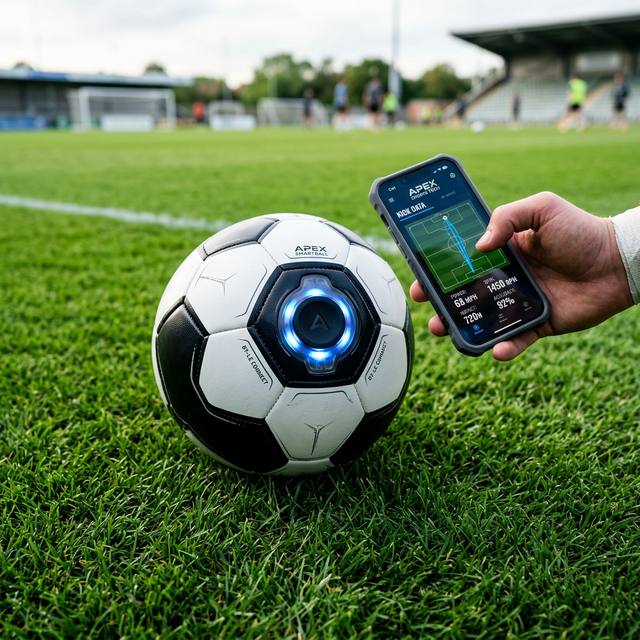
Soccer is seeing a wave of smart training technology, connected balls, wearable trackers, and AI camera systems. Here’s what’s worth the money.
Smart Soccer Tech Ranked
| Product | What It Tracks | Price | Notes |
|---|---|---|---|
| DribbleUp Smart Soccer Ball | Skill training via app | $$ | Best active soccer option |
| PlayerMaker Foot Sensor | Touch count, velocity, work rate | $$$ | Best wearable tracker |
| Playr Football Tracker | Match GPS + performance data | $$ | GPS vest tracker |
| Footbonaut | Passing/receiving skills | N/A | Professional academy setup |
1. DribbleUp Smart Soccer Ball, Best Training Ball
The ball connects to your phone’s camera via augmented reality. The app shows guided drills, tracks your moves, and adapts difficulty. For a deeper buying breakdown, see our best digital soccer ball guide.
DribbleUp
Best for: Youth ages 8-16 who need structured solo training sessions
2. PlayerMaker Foot Sensor, Best Wearable Tracker
Attaches to boot laces. Tracks touches per session, dominant foot ratio, acceleration, and distance. Coaches can review data via dashboard. Used by professional academies.
3. Rebounder Wall Training Net, Best Soccer Rebounder
Angled rebound panel that returns passes and volleys. Train first touch and passing accuracy solo. Essential for skill development between team sessions.
Shop Soccer Rebounder on Amazon
4. SKLZ Goal & Target, Compact Backyard Net
Pop-up goal with target zones for shooting accuracy practice. Lightweight, sets up in 60 seconds.
Training Principles That Still Matter More Than Tech
- 1,000 ball touches per day, Ronaldo reportedly did this at youth age
- Both feet development, weak foot training needs dedicated daily sessions
- Small-sided games, more touches than 11v11 practice
FAQs
Is the DribbleUp ball the same size as a real soccer ball? Yes, it’s a standard Size 5 ball that works as a normal soccer ball without the app.
Can coaches use PlayerMaker data during games? The real-time dashboard is accessible during matches for live monitoring.
How Smart Technology Improves Youth Soccer
Soccer is a sport where decisions happen faster than conscious thought, ball reception, first touch direction, pass selection. Smart training technology helps players build the automatic movement patterns that free up attention for decision-making.
Building a Training Routine with Smart Soccer Tech
Individual training sessions (30 min):
- First 10 min: Ball mastery with a smart ball, tracking touches per minute
- Next 10 min: Passing against a rebounder wall, focusing on proper surface contact
- Final 10 min: Small goal work, placement shooting from varying distances
Using GPS data for conditioning: Review sprint distance and high-intensity running minutes from a GPS tracker (Catapult, FieldWIZ, or GPSports vest). Youth players at U12 level should cover 3–5 km per game; U14+ should reach 6–8 km.
Smart Soccer Products Worth Considering
Beyond what’s listed above, the following tools have strong track records with youth programs:
Rebounder for Passing and Receiving: A Samba Sports or SKLZ QuickSter rebounder provides consistent, accurate ball returns for 1,000+ passing reps per session. The most underrated piece of soccer training equipment at any age.
Check Amazon for Soccer Rebounders
Speed and Agility Ladders: Footwork speed through an agility ladder develops the quick foot placement essential for tight-space ball control. 15 minutes of ladder work 3x weekly shows measurable footwork improvement in 4–6 weeks.
Check Amazon for Agility Ladders
Understanding Soccer GPS Data
GPS trackers used by professional teams are now available in youth-appropriate versions. Key metrics:
| Metric | What it measures | Youth target |
|---|---|---|
| Total Distance | Fitness base | 3–7 km/game by age level |
| High-speed running | Anaerobic capacity | 200–600m/game |
| Sprint count | Explosive actions | 15–40 sprints/game |
| Player Load | Total physical stress | For recovery planning |
What Youth Soccer Coaches Actually Use
Most youth club coaches at the competitive level (ECNL, MLS Next feeder programs) use:
- Video review via Hudl or Veo camera systems
- Small-sided game structures rather than technology-heavy individual drills
- Heart rate monitors for conditioning sessions at U16+
Individual training technology is more valuable for players supplementing team sessions with additional solo practice.
FAQs, Extended
Is the StellarX soccer ball accurate? Smart soccer balls measure speed, spin, and impact zone, their accuracy is generally within 5–10% of professional sensor systems. Good enough for development feedback, not scientific measurement.
At what age is smart soccer training tech appropriate? The fundamentals (rebounder, agility ladder, training ball) are appropriate from ages 7–8. GPS trackers and smart ball sensors add value from around age 12+ when players are doing structured training sessions.
Updated: March 2026, Marcus Webb
Bottom Line
Smart soccer technology is most valuable when it enforces honest accountability, GPS trackers that show distance covered, smart balls that count touches, and video that reveals what your first touch actually looks like versus what you think it looks like. The best coaching tool is accurate feedback, and smart tech delivers it without ego. Choose one or two tools that fit your player’s level and use them consistently.
Updated: March 2026, Marcus Webb
We evaluate sports gear and fitness products independently. To learn more about our editorial standards, read our Editorial Policy.
Related Reading
How we evaluate: We combine manufacturer documentation, independent user feedback, and parent-focused criteria like safety, durability, ease of use, and long-term value.
Accuracy note: Pricing and product availability can change. Verify details on the retailer site before purchase.
Affiliate Disclosure: Sports Gadget Review is a participant in the Amazon Services LLC Associates Program. When you purchase through links on this page, we may earn a commission at no extra cost to you. Editorial recommendations are made independently.