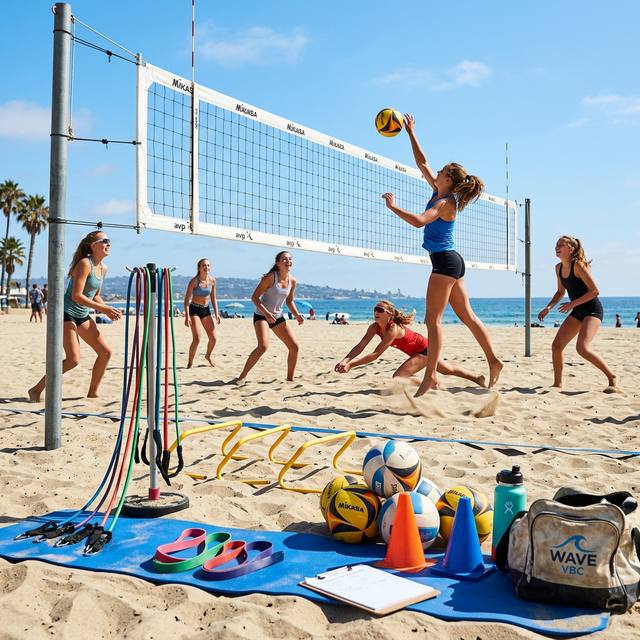
Volleyball players spend hours at practice, but the players who improve fastest get extra reps at home. These tools make home training productive even without a partner.
This page is the solo-rep tool shortlist — spike trainer, heavier training ball, reaction ball. For backyard nets, regulation Mikasa/Molten balls, and the first-three-purchases setup, use the home volleyball training guide. Both URLs stay live; they answer different shopping questions.
Desk research only: manufacturer product sheets, USA Volleyball / FIVB published ball and net specs, and the Amazon title mash-up those families create. Not a lab test this desk ran, not a promised inch-gain study, and not a star rating.
Listing check: Amazon “volleyball training equipment” and “spike trainer” titles mix (1) a bungee-suspended spike trainer (Tandem-class hanging ball) vs a backyard net kit, (2) Tachikara SV-5WSC composite indoor vs a mini, beach, or weighted trainer ball in the same photo, (3) a six-sided reaction ball vs a volleyball, and (4) a serving machine or VertiMax-class jump frame photographed as a “home trainer.” Confirm the variation is the tool you meant — not a net, not a toy ball, not a club machine. Street prices move; treat any dollar figure here as a listing check, not a lock.
Home vs club training aids
| Job | Home / garage | Club / facility — skip for most families |
|---|---|---|
| Extra contacts | Wall, spike trainer, regulation ball | Serving machine with a hopper |
| Approach / vert | Jump rope, bands, a low box | VertiMax-class platform or cable stack |
| Defense | Reaction ball, shuffle on a ladder | Multi-camera film booth |
| Serving accuracy | Sheet or taped wall target | Full court + machine feed |
Skip first a serving machine if you do not have a high ceiling and 20+ feet of clear depth — a garage with a sheet target is the home job. Skip a VertiMax-class jump trainer when a rope and bands are not already a three-times-a-week habit. Skip a second backyard net if the player already has club court time and only needs a hanging trainer. Skip a weighted ball for full-speed arm swings on a young shoulder; keep load for short setting sets. Skip a “volleyball trainer” listing whose photo is a beach kit or a mini ball.
Agility ladders and cone bags that feed approach footwork stay on youth speed and agility equipment. Band progressions live on resistance bands for athletic training.
Top Picks
| Equipment | Best For | Price |
|---|---|---|
| Tachikara Volley-Lite | Arm-friendly serving practice | $ |
| Volleyball Serving Machine | Solo serving/passing reps | $$$ |
| VertiMax Raptor | Explosive jump training | $$$ |
| Tandem Sport Volleyball Trainer | Solo hitting practice | $ |
The $$$ rows are the club skip, not a first cart. Home buyers start with the hanging trainer and a real ball; serving machines and VertiMax-class frames stay in the skip-first column above.
1. Tandem Sport Volleyball Spike Trainer, Best Solo Hitter
A bungee-suspended volleyball that snaps back after you spike it, perfect for working on arm swing and contact point without a setter or partner.
2. Tachikara SV-5WSC Volleyball, Best Training Ball
A slightly heavier official game ball used for arm-strengthening repetitions. Build forearm toughness for serving and passing at full intensity.
3. Sklz Reaction Ball, Agility & Reaction Training
An irregular-shaped ball that bounces unpredictably, trains the quick footwork and reaction time essential for defensive play and passing. On the live listing, confirm it is the six-sided reaction ball — not a volleyball, not a mini trainer. The same SKU is discussed on the agility training equipment kit page.
Shop SKLZ reaction ball listings
4. Resistance Bands for Jump Training
Vertical jump responds to consistent strength and plyometric work. A simple resistance-band program targeting glutes and hamstrings is the home version; treat any “add X inches in Y weeks” claim as marketing, not a measurement this desk ran.
Shop Resistance Bands on Amazon
Home Drills That Work
- Wall passing: Pass overhand and forearm repeatedly against a rebounder wall
- Solo serving: Serve into a hanging sheet target to track accuracy zones
- Jump rope: 10 min daily for footwork and cardio base
FAQs
What’s the best age to start volleyball training equipment? Ages 10-12 are a good starting point for training tools. Younger players benefit more from fundamentals coaching.
Can I train serving effectively without a court? Yes, a garage with 12ft ceilings is enough for serving reps into a net or target.
How to Use These Tools Effectively
Volleyball improvement compounds, every extra hour of quality repetition matters. Here’s how to structure home training using the tools above:
Daily (15–20 min):
- 200 forearm passes against a wall or rebounder, count error-free strings
- 50 overhand passes to a target spot on the ceiling or against a target on the wall
- Jump rope: 5 minutes for footwork and ankle stability
3x Weekly:
- Spike trainer sets: 5 sets of 10 contacts, focusing on arm swing height and snap
- Resistance band squats and calf raises for vertical jump development
Buying Guide: What Actually Matters
Skill level: Beginners benefit most from basic repetition tools, a spike trainer and a heavy training ball. Intermediate and advanced players can use data tools like jump trackers and video analysis.
Position-specific training: Setters should prioritize finger strength and hand positioning (use a weighted training ball). Liberos benefit from reaction training and defensive dive practice. Hitters focus on arm swing mechanics and vertical jump.
Durability: Indoor equipment lasts 3–5x longer than outdoor exposure. If practicing outdoors, buy UV-resistant products and store indoors when not in use.
Vertical Jump Development for Volleyball
Vertical jump is one of the more trainable athletic attributes when the program is progressive and the landings stay quiet. Published coaching programs talk in inches over a season — this desk does not invent a specific gain or a week count.
The core exercises:
- Depth drops: Step off a low box, land softly, immediately jump
- Single-leg heel raises: 3×15 each leg, ankle stability for blocking landings
- Box jumps: Focus on landing mechanics as much as the jump itself
- Broad jumps: Horizontal power transfers to volleyball approach steps
Track progress monthly using a vertical jump measurement app (many free options exist) or the classic chalk-on-wall method.
Video Analysis for Volleyball
Recording practice sets and spikes reveals technique issues invisible during live play. Key things to look for on review:
- Approach timing: Are the last two steps consistently fast and explosive?
- Arm swing path: Does the hitting arm swing from high-to-low, contacting at full extension?
- Platform angle on passing: Is the platform (“shelf”) consistently angled toward the target?
Use Hudl Technique (free) to slow footage to 25% speed and draw annotation lines directly on the video.
FAQs, Extended
How much space do I need for volleyball home training? A garage with 12-foot ceilings handles most solo training, spike trainers, passing walls, and jump training all fit. Serving practice technically needs more height but can be done with abbreviated swings.
What’s the best volleyball for home practice? A standard Tachikara SV-5WSC or Molten V5M5000 are official-weight game balls. For forearm-intensive passing practice (building calluses and arm strength), use a slightly heavier training ball for part of your session.
Is jump rope as effective as a jump trainer machine? Yes, jump rope is underrated for athletic development. 10 minutes daily builds calf strength, ankle stability, and footwork coordination better than most expensive jump training devices.
Expert Tips for Effective Home Volleyball Training
Arm conditioning is the foundation of volleyball serves and spikes. Incorporate serving practice against a wall or rebounder system, focusing on topspin contact points rather than pure power. For setters, solo practice with a training ball against a smooth wall builds the muscle memory to deliver consistent, hittable sets. Passers benefit most from partner pepper drills, if you’re training solo, a rebounder and serve machine combination makes this possible. Consistent daily repetition at 30 minutes per session delivers measurable improvement within 4-6 weeks.
We evaluate sports gear and fitness products independently. To learn more about our editorial standards, read our Editorial Policy.
Related Reading
How we evaluate: We combine manufacturer documentation, independent user feedback, and parent-focused criteria like safety, durability, ease of use, and long-term value.
Accuracy note: Pricing and product availability can change. Verify details on the retailer site before purchase.
Affiliate Disclosure: Sports Gadget Review is a participant in the Amazon Services LLC Associates Program. When you purchase through links on this page, we may earn a commission at no extra cost to you. Editorial recommendations are made independently.