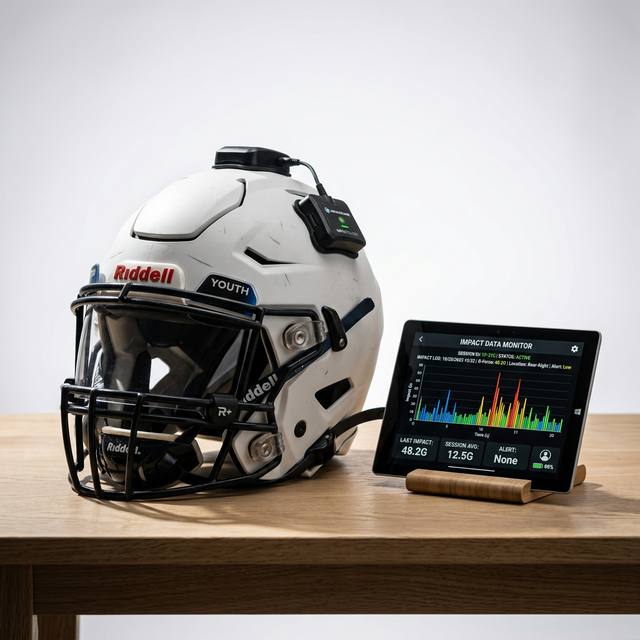
Head safety is the most important decision in youth football equipment. Modern helmets now incorporate impact sensors and fit technologies that reduce injury risk measurably. Here’s what to know.
How to read NOCSAE vs Virginia Tech stars — and why an Amazon “5-star” title is not the live youth table — lives on youth football helmet safety ratings. This page is the model-and-sensor shopping list.
Top Youth Football Helmets
| Helmet | Safety Rating | Smart Features | Price |
|---|---|---|---|
| Riddell SpeedFlex | STAR 5-star | Optional sensor | $$$ |
| Vicis Zero2 Youth | STAR 5-star | Fit check | $$$ |
| Riddell Precision-Fit | STAR 4-star | Custom liner | $$$ |
| Schutt Vengeance A11 | STAR 4-star | None | $$ |
1. Vicis Zero2 Youth, Best Safety Performance
Consistently top-rated by the Virginia Tech STAR system. Soft outer shell and segmented column liner absorb impact from multiple directions, addressing oblique hits that traditional hard shells don’t handle well.
STAR rating: Consistently ranked #1-3 in youth helmet safety
2. Riddell SpeedFlex, Most Popular High School Helmet
Industry standard for quality. Flex panel in the front absorbs some frontal impact energy. Optional InSite Link sensor module clips inside and alerts coaches to significant impacts via sideline app.
3. Schutt Vengeance A11 Youth, Best Value Safety
Strong STAR rating at a more accessible price point. Dual-density foam liner, multiple ventilation channels. Best step up from basic beginner helmets.
Understanding Virginia Tech STAR Ratings
The STAR system rates helmets on how well they reduce risk of concussion across a battery of impact tests. 5-star helmets reduce concussion risk by 54% compared to 1-star helmets.
Always buy a 4-star or 5-star rated helmet. The rating list is updated annually at helmet.beam.vt.edu.
Fit Is as Important as Helmet Model
A 5-star helmet that fits poorly performs worse than a 3-star helmet with proper fit. Measure head circumference and compare to manufacturer sizing charts. Have a certified equipment manager or coach certified fitter do the final fitting.
FAQs
How often should youth football helmets be recertified? Every 2 years under NOCSAE standards. Check for the recertification sticker.
At what age can kids start tackle football? Most medical organizations recommend flag football until age 14. Whatever age you start tackle, proper helmets matter.
Understanding Youth Football Helmet Safety Ratings
Not all football helmets are created equal, and the safety rating system has improved dramatically in the past five years. Here’s what the ratings actually mean:
NOCSAE certification: The minimum legal standard. Every helmet sold for youth football must be NOCSAE certified.
Virginia Tech STAR rating: The most rigorous independent rating system. Tests measure how well a helmet reduces rotational acceleration, the mechanism linked to concussion injury. A 5-star rating indicates top-tier protection.
Riddell’s InSite system: An impact monitoring layer built into select Riddell helmets that sends real-time impact data to sideline tablets. Used at the high school and college level; some youth programs are beginning to adopt it.
Proper Helmet Fit: The Most Important Safety Factor
Even the best-rated helmet is ineffective if it doesn’t fit correctly. Fit protocol:
- Measure head circumference at the widest point (1 inch above the eyebrows)
- Select the size that puts the helmet one finger-width above the eyebrow ridge
- Check that the jaw pad contacts the jaw on both sides
- The chin strap should be snug, no slack, no pinching
- Perform the “push and rotate” test: the helmet should not move on the head when pushed at the front, back, or rotated side to side
Recertification: Helmets must be recertified after 10 years per NOCSAE standards. Most manufacturers recommend recertification every 2 years for youth use.
Position-Specific Considerations
Linemen: Prioritize maximum padding and side impact protection, linemen absorb repeated lower-force impacts every play.
Skill positions (QB, WR, RB): Look for helmets with strong facemask positioning and good peripheral vision, crucial for tracking the ball.
Defensive backs and linebackers: Impact sensors in helmets like the Riddell SpeedFlex Precision give coaches and parents a data record of high-force impacts.
Impact Monitoring Technology
Smart sensors embedded in helmets or in the chinstrap measure acceleration forces from each impact. Systems like Riddell InSite, Penumbra’s mouthguard sensor, and Guardian Cap’s sensor layer give sideline staff real-time alerts when an impact exceeds a threshold.
These systems don’t diagnose concussions, that requires medical evaluation, but they help identify which athletes should be evaluated after a practice or game.
FAQs, Extended
How often should youth football helmets be replaced? Helmets should be inspected annually and recreconditioned every 2 years. Replace immediately after any significant direct impact that leaves a visible dent or cracking in the foam liner.
Are more expensive helmets always safer? Not directly. Virginia Tech STAR ratings show that some mid-priced helmets outperform expensive ones. Always check the current Virginia Tech rating for any helmet you’re considering, ratings are updated annually.
What is a Guardian Cap and should my child wear one? A Guardian Cap is a soft-shell cover worn over a standard helmet. Studies show it reduces impact severity in practice by 10–20%. Many youth leagues and high school programs now require them for practice. They add safety without replacing the need for a properly rated helmet.
Updated: March 2026, Marcus Webb, Lead Sports Tech Reviewer
We evaluate sports gear and fitness products independently. To learn more about our editorial standards, read our Editorial Policy.
Related Reading
How we evaluate: We combine manufacturer documentation, independent user feedback, and parent-focused criteria like safety, durability, ease of use, and long-term value.
Accuracy note: Pricing and product availability can change. Verify details on the retailer site before purchase.
Affiliate Disclosure: Sports Gadget Review is a participant in the Amazon Services LLC Associates Program. When you purchase through links on this page, we may earn a commission at no extra cost to you. Editorial recommendations are made independently.