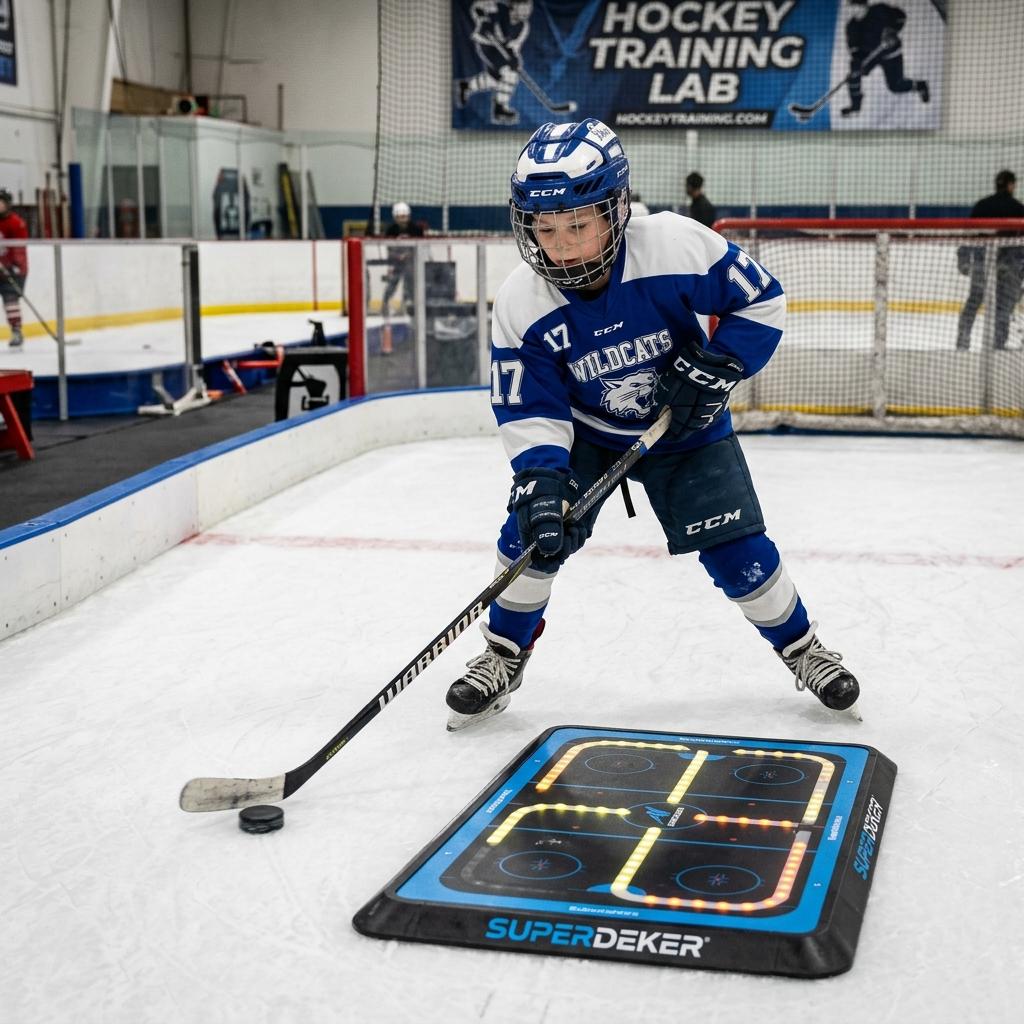
Hockey is the most equipment-intensive youth sport, and one of the most expensive. But amid the gear spending, there’s a small category of training technology and skill aids that genuinely improve how fast young players develop. I’ve coached youth hockey and tested these tools through full seasons, so this is what I’d actually recommend to hockey parents in 2026.
Safety First: Helmet Technology
Bauer Re-Akt 200, Best Smart Safety Helmet (~$249)
For contact-sport parents concerned about head safety, Bauer’s Re-Akt 200 uses VTT (Variable Thickness Technology) foam that stiffens on high-speed impacts and softens on lower-speed impacts, adapting to real-game conditions.
While not a “smart” helmet in the sensor sense, it consistently earns top marks in Virginia Tech’s independent STAR helmet ratings, the most objective concussion protection benchmark available.
Parent note: Any youth hockey helmet should be replaced after a significant impact, even if there’s no visible damage. The foam compresses and doesn’t recover.
Stickhandling & Skills Trainers
HockeyShot Extreme Passing Kit ($89)
Two heavy-gauge rubber rebounders that you set up in a garage or basement. Pass to one rebounder, receive off the other, trains both hands equally and forces cross-ice reads. Used by players at the AAA travel level all the way down to beginners.
The anchoring system actually holds on concrete, unlike cheaper alternatives that slide on every pass.
Best for: All skill levels. One of the best per-dollar training investments in the sport.
Sniper’s Edge Dryland Stickhandling Board ($39)
A slippery synthetic surface that mimics ice so a puck slides realistically during off-ice stickhandling drills. Place it on any flat surface, basement floors, driveways, even carpet with a rubber mat underneath.
More kids burn out on overpriced gear than on under-practicing. This $39 board plus 20 minutes a day will develop soft hands faster than any app.
Revolver Stickhandling Trainer ($79)
A spinning platform with a puck that mimics unpredictable deflections, forces adaptive hands. Where the flat board teaches basic handling, the Revolver trains reactive puck control under pressure.
Shot Training
HockeyShot Radar App Bundle, Tracking Shot Speed
The HockeyShot radar pairs with an iPhone to measure shot speed and logs data over time. For teens 12+, tracking shot speed improvement provides the same motivation as lap times in swimming, objective data that proves hard work is paying off.
Skating Development
For players who don’t have access to ice year-round, slide boards develop the lateral movement pattern and hip extension critical to skating power:
ProSlide Lacquered Slide Board ($129)
A 6-foot slick board with foam end stops, replicates the push-and-glide pattern of skating on any floor. 20 minutes three times a week will meaningfully improve stride efficiency.
Wearables for Hockey
The Garmin Forerunner 55 works for hockey conditioning monitoring between ice sessions. For in-game use, impact monitoring is increasingly relevant:
The Jolt Sensor (clips to any helmet or headband) sends real-time impact alerts to a parent’s smartphone. At $99, it’s a meaningful safety layer for contact hockey, especially for players in leagues without certified athletic trainers at every practice.
What I Skip
- Skating treadmills: Expensive, rare, and a rink-based skating lesson teaches more per dollar
- Shot-blocking training pads: Kids need practice on actual technique, not teaching their body when it’s “safe” to get hit
- Overpriced custom sticks for beginners: Buy a mid-range composite, spend the rest on ice time
FAQs
At what age can kids start using training aids? Stickhandling boards and passing rebounders work from age 6+ with parental supervision. Radar guns and impact sensors are better for ages 10+.
How important is off-ice training for youth hockey? At the squirt and peewee levels, ice time is the most important investment. Off-ice skill tools are supplemental, use them to extend practice between ice sessions, not replace it.
Should I buy all of these? No. Start with a stickhandling board. Add the passing kit if there are two players in the house. Add radar and the slide board for competitive players 12+.
Updated: March 2026 by Marcus Webb
Position-Specific Training for Youth Hockey
Different positions demand different training tools:
Forwards: Stickhandling speed and shooting accuracy. Puck rebounders and shooting targets are the highest-value tools.
Defensemen: Backward skating agility and gap control. Off-ice lateral movement ladders and slide boards simulate the specific movements defensemen need.
Goalies: Reaction time and lateral movement. Dedicated goalie-specific rebounders and reaction balls develop the unpredictable bounce responses goalies face.
Off-Ice Training That Actually Transfers
The best youth hockey programs integrate significant off-ice training. Here’s what translates directly to on-ice improvement:
Slide board training: A long, friction-reduced board with end blocks mimics the lateral skating push motion. 20 minutes of slide board work daily is the closest off-ice analog to actual skating. The Ultraslide Board is the standard for youth hockey programs.
Stickhandling aids: The Sniper’s Edge stickhandling board (a smooth surface for on-ice-like puck movement resistance) and the Biscuit training puck (lightweight indoor puck for ball hockey surfaces) are both worth having for daily off-ice stickhandling practice.
Shooting mechanics: The primary shooting issue in young players isn’t strength, it’s technique. Video yourself shooting (phone on a tripod) and review in slow motion. Shooting coaches universally identify the same errors: lifting the head too early, not loading the bottom hand, limited hip rotation.
Smart Helmet Technology in Youth Hockey
Riddell InSite and Prevent Biometrics Smart mouthguards track head impacts during play. Youth hockey has begun adopting these systems at the bantam (13–14 yo) and midget (15–17 yo) levels.
The data collected isn’t used to diagnose concussions, that requires medical evaluation, but it helps coaches and parents identify which athletes absorbed high-force impacts and should be evaluated.
Training Program for the Off-Season
A structured 12-week off-season hockey training program:
Weeks 1–4: Foundation
- Slide board: 15 min × 4 days/week
- Stickhandling: 200 reps daily
- General athletic training: sprint mechanics, lateral movement
Weeks 5–8: Development
- Slide board: 20 min × 5 days/week
- Shooting against net: 100 shots/day with focus on mechanics
- Video review: monthly technique comparison
Weeks 9–12: Pre-season
- Add skating sessions if ice is available
- Increase shooting intensity and accuracy targets
- Scrimmage-style small net competitive games
FAQs, Extended
What age should youth players start using training aids? Basic stickhandling aids are appropriate from age 7–8. Position-specific tools (slide boards, shooting trainer nets) add value from around age 10 once basic mechanics are established.
Is the Bauer Smart Helmet worth the price? The Bauer Re-Akt 200 with SmartTech sensor provides meaningful impact monitoring data at a price point ($350+) that’s significant for youth budgets. For programs that can afford it, the safety insight is valuable.
Updated: March 2026, Marcus Webb, Lead Sports Tech Reviewer
We evaluate sports gear and fitness products independently. To learn more about our editorial standards, read our Editorial Policy.
Related Reading
How we evaluate: We combine manufacturer documentation, independent user feedback, and parent-focused criteria like safety, durability, ease of use, and long-term value.
Accuracy note: Pricing and product availability can change. Verify details on the retailer site before purchase.
Affiliate Disclosure: Sports Gadget Review is a participant in the Amazon Services LLC Associates Program. When you purchase through links on this page, we may earn a commission at no extra cost to you. Editorial recommendations are made independently.